Published on 1 September 2026

Before you commit to any business loan, you need to know what it will actually cost. A business loan calculator lets you run the numbers in minutes, testing different amounts, terms, and interest rates until you find a structure that fits your cash flow. This guide walks you through how to use one effectively, what the outputs really mean, and how to move from rough estimate to a real funding decision for your UK SME.
What is a Business Loan Calculator?
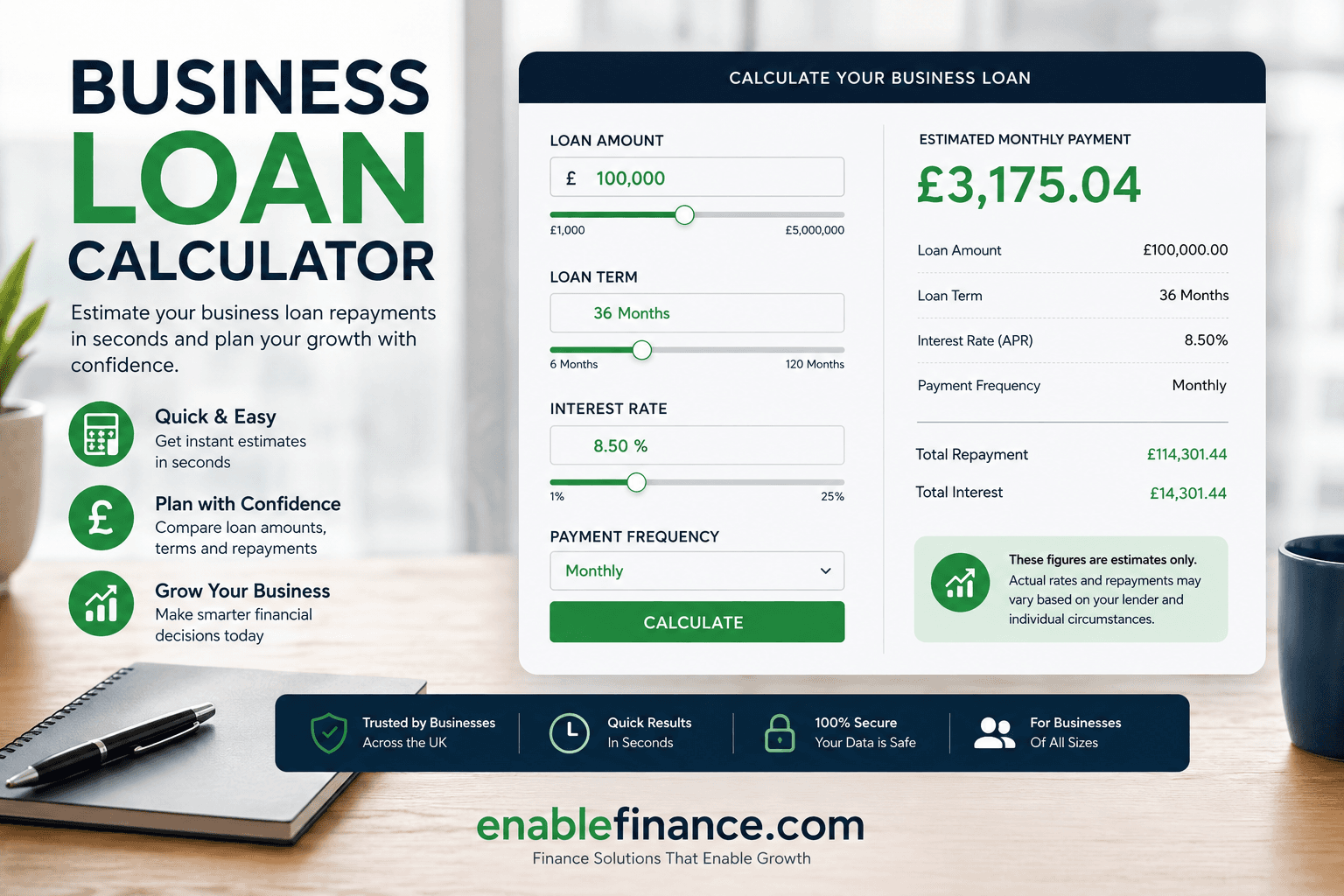
A business loan calculator is an online tool that estimates your repayments, total interest, and the overall cost of borrowing before you speak to a lender. Business loan calculators estimate monthly repayments and total costs, giving you a clear picture of affordability without any obligation.
Enable Finance's loan calculator is built for UK businesses and brokers. It uses realistic annual interest rate bands, typical arrangement fees, and lending terms that reflect what the UK market actually offers in 2026, rather than generic global assumptions. Calculators can include fees to determine the true APR, which means you get a more honest view of the loan's actual cost from the start.
It is worth noting that results are always indicative, not a binding offer. Different lenders calculate interest in different ways. Some use a reducing-balance method where interest falls as you repay principal, while others apply a flat rate on the original loan amount throughout the term, which results in a higher effective cost. Amortization schedules show how loans are repaid over time, and a good calculator will reflect this clearly.
Here is what a well-built business loan calculator should show you:
- Monthly repayment amount based on your chosen inputs
- Total amount repayable over the full loan term
- Total interest paid across the life of the loan
- Estimated annual percentage rate inclusive of fees
How to Use Enable Finance's Business Loan Calculator (Step-by-Step)
Getting started takes less than two minutes. Here is how to work through it:
- Enter your loan amount. Users can input loan amounts from £1,000 to £20 million, covering everything from a small business loan to large secured commercial deals.
- Set your term length. Choose months or years to define the repayment period, from as short as three months for bridging needs up to 25 years for commercial property loans.
- Input an interest rate. Use the annual interest rate you have been quoted, or select from typical rate bands based on whether your loan is secured or unsecured.
- Add optional fees. Include any upfront arrangement fees as a percentage, plus flat fee amounts for documentation or broker costs. You can also toggle between monthly and quarterly repayment frequency.
- Choose your interest type. Select whether the rate is a fixed interest rate or variable, and whether the structure is fully amortising or interest-only during an initial period.
The output screen gives you a clear monthly repayment figure, the total cost of credit, and a summary breakdown of principal versus interest. From there, you can request a personalised quote from Enable Finance's lending panel. Some applicants may then continue through online banking if their lender supports it.
Using the calculator does not impact your credit score. It runs on illustrative assumptions only, with no credit check involved, so you can test as many scenarios as you like without affecting your credit score.
Business Loan Calculator
Loan calculator
Simulate payments, rates, and cash-flow impact.
Example estimate: £50,000 over 24 months at 8.9% APR ≈ £2,282/month (illustrative).
Qualifying criteria
Estimated monthly
£2,282
Illustrative quotes only. Actual rates confirmed at underwriting. Enable Finance does not provide regulated financial advice.

Quick Example: Estimating a UK SME Business Loan in 2026
Let us put numbers to it. Imagine you need a £150,000 business loan over five years at an annual interest rate of 9.9%, which is a plausible mid-range rate for a standard UK SME term loan in early 2026.
Using the calculator with reducing-balance interest and monthly repayments, here is what you would see:
- Loan amount: £150,000
- Loan term: 60 months
- Annual interest rate: 9.9%
- Approximate monthly repayment: £3,230
- Total interest paid: approximately £43,800
- Total amount repayable: approximately £193,800
Understanding the loan's total repayment amount is critical to financial planning. Most business loans require monthly repayments including interest, so this figure feeds directly into your budgeting.
Now consider how changing the inputs shifts the picture. Extending the term to seven years drops the monthly payment but pushes total interest above £55,000. Securing the loan against property might reduce the rate to 6–7%, cutting total interest by nearly half. Shortening the term to three years increases the monthly repayment sharply but saves thousands in interest charges. Enable Finance's advisers can refine these figures based on your sector, security available, and credit profile, acting in effect as a specialist business loan broker to find your ideal financing solution.
What Is a Business Loan and How Does It Work?
A business loan is money borrowed solely for business purposes, repaid with interest and fees over an agreed loan term. It differs from a personal loan in that lenders assess the trading performance, business structure, and commercial viability of the company rather than just the individual behind it.
In the UK, business loans come in a wide range of sizes. SME business loans typically range from £10,000 to £500,000 for an unsecured loan facility, allowing collateral-free borrowing. Secured or asset-backed deals can run from £100,000 to well over £5 million when commercial property or substantial business assets are involved. Microloans can be approved for up to £50,000, with the average sitting around £15,000. For comparison, SBA loans in the US can be as large as $5 million for up to 10 years, while SBA 7(a) loans can finance working capital, equipment, and business acquisitions. Microloans in the US typically average no more than $15,000.
Common uses include working capital to cover day-to-day expenses, purchasing equipment or vehicles, bridging short-term cash flow gaps, and funding growth projects or acquisitions. Loan applications should clearly outline the specific purpose of the funds needed, as loan purpose influences lender decisions on credit approval and payment terms. Borrowing for equipment or expansion requires aligning the loan's term with the asset's lifespan.
The total cost of borrowing includes principal, interest, and all fees. Here are the key moving parts:
- Principal: the amount you actually borrow
- Business loan interest: the cost the lender charges for providing the funds, expressed as an annual interest rate
- Business loan fees: arrangement, legal, valuation, broker, and exit fees layered on top
- Repayment schedule: the agreed structure for paying back both the principal and interest over the term
Responsible borrowing can support growth, protect cash flow, and help build a stronger business credit score over time.
Key Inputs in a Business Loan Calculator
Every loan calculator relies on the same core inputs. Understanding what each one does helps you model realistic scenarios rather than misleading ones.
- Loan amount: the sum you want to borrow. For UK SMEs, this typically sits between £10,000 and £750,000 unsecured, or higher for secured deals.
- Term length: how long you have to repay. Shorter terms mean higher monthly interest costs per payment but lower total interest overall.
- Annual interest rate: this can be fixed or variable. Variable-rate loans may change payments based on interest rate fluctuations, so stress-test your numbers by adding a percentage point or two. A fixed interest rate locks your repayment amounts for the full term.
- Repayment frequency: monthly is standard, but some lenders offer quarterly or even annual repayment options.
- Fees: input arrangement fees as a percentage and flat fee amounts for documentation or broker charges. A 4% arrangement fee on a £10,000 loan over 12 months at 15% raises the effective APR from roughly 15% to around 19.4%.
- Interest-only toggle: interest-only periods are an option in some business loans during initial repayment phases, particularly bridging loans or development finance.
The annual percentage rate gives a truer comparison between funding options than a headline rate alone because it wraps in fees and compounding effects. Always compare APR to APR rather than nominal rate to nominal rate.
Enable Finance's calculator can model both amortising term loans, where each monthly payment covers interest and a portion of principal, and interest-only structures where you pay interest only during the term and repay the principal at the end.
Understanding the Results: Monthly Repayments, Total Interest and APR
Once you hit calculate, the results section should give you four figures that matter:
- Monthly repayment amount: what leaves your business bank account each month
- Total amount payable: the full sum you will hand over across the life of the loan
- Total interest: how much you pay interest on top of the principal
- Estimated APR: the annual cost expressed as a single percentage, inclusive of fees
APR is more useful than looking at a headline business loan interest rate alone. A loan advertised at 8% with a 3% arrangement fee will cost materially more than a loan at 9% with no fee. Fees and charges can significantly impact the total cost of a loan, and APR captures that difference.
Comparing multiple loan offers can help identify the best financing option. Here is how SMEs can put these results to work:
- Compare two competing offers side by side using the same calculator
- Decide between shorter, higher repayments and longer, lower repayments by looking at total interest
- Feed the monthly repayment figure into your cash flow forecasting to check affordability
- Share the output with Enable Finance's team to match it against real lender terms from the UK funding panel
Types of Business Loans You Can Model with the Calculator
One business loan calculator can approximate costs for several types of business finance, though each product has its own nuances. Here is how closely the calculator mirrors each one.
Traditional business loans, both secured and unsecured term loans, are the calculator's sweet spot. You enter the amount, term, and rate, and the output is highly accurate for standard amortising repayments. Such loans are the bread and butter of UK SME finance, with secured business loan interest rates typically sitting between 5% and 12% APR and unsecured business loans ranging from 10% to 45% APR depending on risk profile.
Working capital loans and commercial property loans also model well. Commercial property loans can have terms of 5 to 25 years, so extending the term input in the calculator gives a reasonable estimate. For commercial mortgage scenarios or secured vs unsecured business bridging loans, remember to add valuation and legal fees as flat costs.
Bridging loans and asset finance are partially compatible. Bridging loans often use interest-only or rolled-up interest structures, so the calculator's interest-only toggle helps, but exit fees and short-term compounding need manual adjustment. Asset finance structures may include deposits and balloon payments that a basic calculator will not capture precisely.
Post-insolvency funding, such as CVA or pre-pack administration finance, involves bespoke pricing driven by turnaround risk and security negotiations. The calculator offers a starting point, but Enable Finance's specialists provide tailored illustrations for these complex cases.

Secured vs Unsecured: How the Calculator Helps You Compare
Secured business loans are backed by collateral such as property, equipment, or other business assets. Unsecured business loans rely primarily on credit history, trading performance, and cash flow strength, and an unsecured loan offers a collateral-free option. The difference in pricing between the two can be dramatic.
Collateral reduces the lender's risk in securing a loan, which is why secured rates tend to sit between 5% and 12% APR while unsecured rates can reach 30% to 45% for higher-risk borrowers. To see this in practice, run two scenarios in the calculator: one at 7% secured and one at 20% unsecured for the same loan amount and term. On a £200,000 loan over five years, the monthly repayment difference could be several hundred pounds, and the total interest gap runs into tens of thousands.
Lenders evaluate business financing applications based on the 5 Cs of Credit: Character, Capacity, Capital, Collateral, and Conditions. Secured loans lean heavily on collateral and conditions, while unsecured lending places more weight on character and capacity.
When comparing secured versus unsecured, check these factors in the calculator:
- Interest rate: secured will almost always be lower
- Loan term: secured often allows longer repayment periods
- Fees: secured loans may carry valuation and legal fees that unsecured loans avoid
- Flexibility: unsecured loans are typically faster to arrange and carry no risk to business assets
- Speed: traditional lenders offering secured deals may take weeks; unsecured can complete in days
Enable Finance can advise whether security is likely to be required based on loan amount, sector, and your business credit score.
On Secured Business Loan Calculator with Monthly Interest
Unsecured business loan calculator
Estimate monthly repayments and total cost with interest on the reducing balance, not a flat rate.
Example estimate: £50,000 unsecured reducing-balance loan at 1.99%/month over 12 months ≈ £4,961/month; equiv. APR 39.2% (illustrative).
Charged on the loan amount and added to the balance you repay.
Estimated monthly repayment
£4,961.33
Illustrative quotes only. Actual rates confirmed at underwriting. Enable Finance does not provide regulated financial advice.
Using a Business Loan Calculator for Asset Finance and Equipment Purchases
Asset finance covers funding for vehicles, machinery, IT infrastructure, and other tangible assets, often structured as hire purchase or finance leases. In the UK, the asset itself typically serves as security, which means rates tend to be lower than unsecured business loans.
You can use the calculator to estimate repayments for a specific piece of equipment. For example, an £80,000 CNC machine financed over four years at 7.5% APR would produce a monthly payment of approximately £1,935, with total interest around £12,880. Set the interest rate input to reflect the lower risk profile of asset-backed lending for a more accurate result.
Enable Finance brokers can source asset finance from specialist lenders and align calculator assumptions with real-world offers, including structures like asset refinance or sale and leaseback.
When to choose asset finance over a general term loan:
- The asset has a clear resale value that supports security
- You want to preserve working capital rather than pay cash upfront
- The asset's productive life matches or exceeds the loan term
- You need to spread the annual cost of a major purchase across its useful life
Business Credit Score: How It Affects Your Loan Estimates
Your business credit score is a numeric summary of your company's creditworthiness, compiled by agencies such as Experian Business, Creditsafe, and Dun & Bradstreet. Business credit scores are separate from personal credit scores, though managing personal finances can positively impact business credit scores, especially for sole traders and director-guaranteed lending.
Credit scores impact the interest rates and terms offered by lenders. A stronger score typically means lower annual interest rate bands, smaller arrangement fees, and access to more funding options. A higher credit score can lead to better loan interest rates, potentially shifting you from the 20%+ unsecured band down into the 10–15% range. A good credit score opens more funding options across traditional lenders and alternative platforms alike.
Cash flow and revenue are critical for lenders to assess repayment ability. Adequate cash flow is essential to cover loan repayments and operational expenses, and lenders typically require key financial documents to evaluate loan applications, including financial statements filed at Companies House, recent bank statements showing your business bank account activity, and up-to-date management accounts.
Using Enable Finance's calculator does not involve a credit check, so there is no risk of affecting your credit score. If your score needs work, you can still explore options. Enable Finance has guidance on getting a business loan with bad credit.
Steps to improve your business credit score so future calculator estimates reflect cheaper borrowing:
- Make all supplier and loan repayments on time; consistent repayments can help rebuild a business credit profile
- Avoid maxing out your business credit card
- File accounts at Companies House promptly
- Keep personal guarantee exposure manageable and personal finances in good order
- Monitor your credit history regularly for errors

Business Loan Fees and Hidden Costs to Include in Your Calculations
Fees can turn a competitive-looking interest rate into an expensive loan. Here are the most common UK business loan fees to factor in:
- Arrangement fees (also called origination fees): typically 1% to 3% of the loan amount for standard business loans, though origination fees can range from 1% to 6% in higher-risk or specialist deals
- Broker fees: may be commission-based (paid by the lender) or charged directly to the borrower at 0.5% to 1.5%, or as a flat fee
- Valuation and legal fees: relevant for secured and commercial property loans, often charged as fixed amounts
- Documentation fees: these cover the cost of processing paperwork and are usually a flat fee added at completion
- Application fees: some financial institutions charge these upfront to review the loan application
- Late payment fees: these apply if repayments are not made on time, and they add up quickly
- Prepayment penalties: these may be charged for paying off a loan early, reducing your flexibility to clear debt ahead of schedule
- Exit or redemption fees: a final administration charge when the facility closes
To include a flat fee in the calculator's effective APR, convert it to a percentage of the loan amount. For example, a £2,000 legal fee on a £100,000 loan adds 2% to the cost, which can be combined with the arrangement fee input.
Some lenders charge higher rates but low fees, while others quote a low headline rate and load up on arrangement fees. The calculator helps reveal the actual cost by showing the total repayable figure rather than just the monthly payment.
Enable Finance discloses its own broker fees clearly and can model them alongside lender costs. Before accepting any offer, run through this checklist:
- Arrangement or origination fees confirmed in writing
- Broker fees disclosed and agreed
- Valuation and legal fees estimated
- Early repayment or exit fees noted in the loan agreement
- All fees included in your calculator's total cost figure
Planning Cash Flow with a Business Loan Calculator
Once you know your projected monthly repayment, overlay it onto a 12 to 36 month cash flow forecast. Stable, predictable repayment amounts help you plan staff costs, stock purchases, tax payments, and seasonal fluctuations with confidence.
Here are practical ways SMEs use calculator outputs for cash flow forecasting:
- A retailer bridging a winter revenue dip can model a short-term working capital loan and confirm that spring sales cover the repayment schedule comfortably
- A contractor covering VAT on materials can check whether a VAT loan repayment fits alongside project milestone payments
- A manufacturer planning equipment purchases can compare the monthly payment on asset finance against the revenue the new machine will generate
The calculator also works alongside other funding options. For instance, combining a term loan for a capital purchase with invoice factoring for ongoing cash flow or comparing invoice factoring v invoice discounting gives you a blended finance strategy that spreads risk and smooths your actual repayments.
Enable Finance's advisers and AI-powered software tools help brokers and business owners test different structures for resilience, ensuring your business can access funds when needed without overcommitting on monthly obligations.
Alternative Funding Options a Calculator Might Not Capture Perfectly
Some products do not fit neatly into a standard amortising loan calculator. It is important to understand where the calculator is useful and where you need product-specific advice.
Invoice financing and invoice factoring allow you to draw cash against outstanding invoices, typically receiving 80% to 95% of invoice value upfront. When choosing a provider, ask 10 essential questions for selecting the right invoice factoring company. Costs depend on debtor quality, turnover volume, and the provider's fee structure rather than a fixed interest rate, making the calculator a rough guide at best.
A merchant cash advance is repaid as a percentage of card sales, meaning repayment amounts fluctuate with revenue. Merchant cash advances can have APRs over 100%, so while the calculator can model a flat fee equivalent, the actual cost depends on how quickly you repay through card volumes, much like understanding the true cost and fees of invoice factoring requires digging into the detailed pricing structure.
Business overdrafts and revolving credit facilities charge interest only on what you draw, not a fixed principal. A standard calculator cannot replicate this usage-based pricing.
Government backed loans, such as those under the Growth Guarantee Scheme, may have subsidised terms that differ from commercial pricing. Traditional loans from credit unions or community lenders may also carry non-standard structures.
Here is a quick compatibility guide:
| Product | Calculator accuracy |
|---|---|
| Term loans (secured and unsecured) | Excellent |
| Asset finance / hire purchase | Good (adjust for deposits) |
| Bridging loans | Fair (use interest-only toggle) |
| Invoice financing | Poor (turnover-dependent) |
| Merchant cash advance | Poor (sales-dependent) |
| Revolving credit / overdrafts | Poor (usage-dependent) |
Enable Finance sources all of these specialist solutions and can provide more accurate, product-specific illustrations on request for alternative funding options that the calculator cannot model precisely. Its finance and business blog also tracks changing UK funding schemes and market conditions that may affect the pricing your calculator estimates.

Getting a Personalised Quote with Enable Finance
A calculator gives you the estimate. A personalised quote gives you exact payment terms from a real lender. Here is how to move from one to the other with Enable Finance.
Start by running your scenarios in the calculator to narrow down the loan amount, term, and cost range that works for your business. Then reach out to Enable Finance's team, who use AI-powered sourcing software to match your deal to suitable UK lenders quickly. SMEs, brokers, and lenders all use the platform, and response times for initial indicative terms are typically measured in hours for unsecured deals and days for secured or complex structures. Approval for loans with additional paperwork, such as government backed loans, may take longer due to the documentation involved.
To move to a formal application, you will generally need:
- Recent business accounts (last one to two years)
- Three to six months of bank statements from your business bank account
- Details of any existing actual loan facilities or business finance commitments
- Information on assets available for security, if applicable
- A brief outline of what the funds are for
You can apply for a business loan online, via an app, or through online banking where supported by the lender, and Enable Finance's process is designed to be digital-first with minimal impact on your business credit score. Business finance experts on the team review each case and guide you through repayment terms, loan options, and the fine print of any loan agreement.
Whether you are a business owner seeking working capital, a broker sourcing deals for business customers, or a lender looking for deal flow, Enable Finance's platform covers the full spectrum of business finance from traditional lending to specialist post-insolvency funding, acting as one of the best business loan brokers for finding your ideal financing solution.
- Use the calculator to estimate your borrowing costs
- Speak to Enable Finance's team for tailored UK business finance options
- Get matched to lenders from our panel and access funds with confidence